
Notification Center

Florian Einböck
23 Oct 2026 | 6 min read
A generic platform for Object Controllers is best judged by how it performs in practice. Decentralised, standardised architectures have been discussed as the future of signalling for some time – the more interesting question is how they can be applied to the very different requirements operators face today. Three scenarios built around the Frauscher Advanced Platform FAdP illustrate this: a multi-vendor integration under real operating conditions, a space- and cost-driven consolidation, and a pragmatic migration path for legacy infrastructure. The first is already being implemented in the field.
The Digirail project of the Finnish Transport Infrastructure Agency (FTIA) marks a milestone for European signalling technology: for the first time, Object Controllers were tendered separately from the central safety system. Frauscher Sensor Technology supplies EULYNX-compliant Object Controllers: One for point control, based on FAdP and one for train detection, based on the proven Frauscher Advanced Counter FAdC®, via system integrator Mipro Oy, working alongside Siemens and Relesoft to integrate both with the Siemens DS3 interlocking via the standardised EULYNX interfaces SCI-P and SCI-TDS.
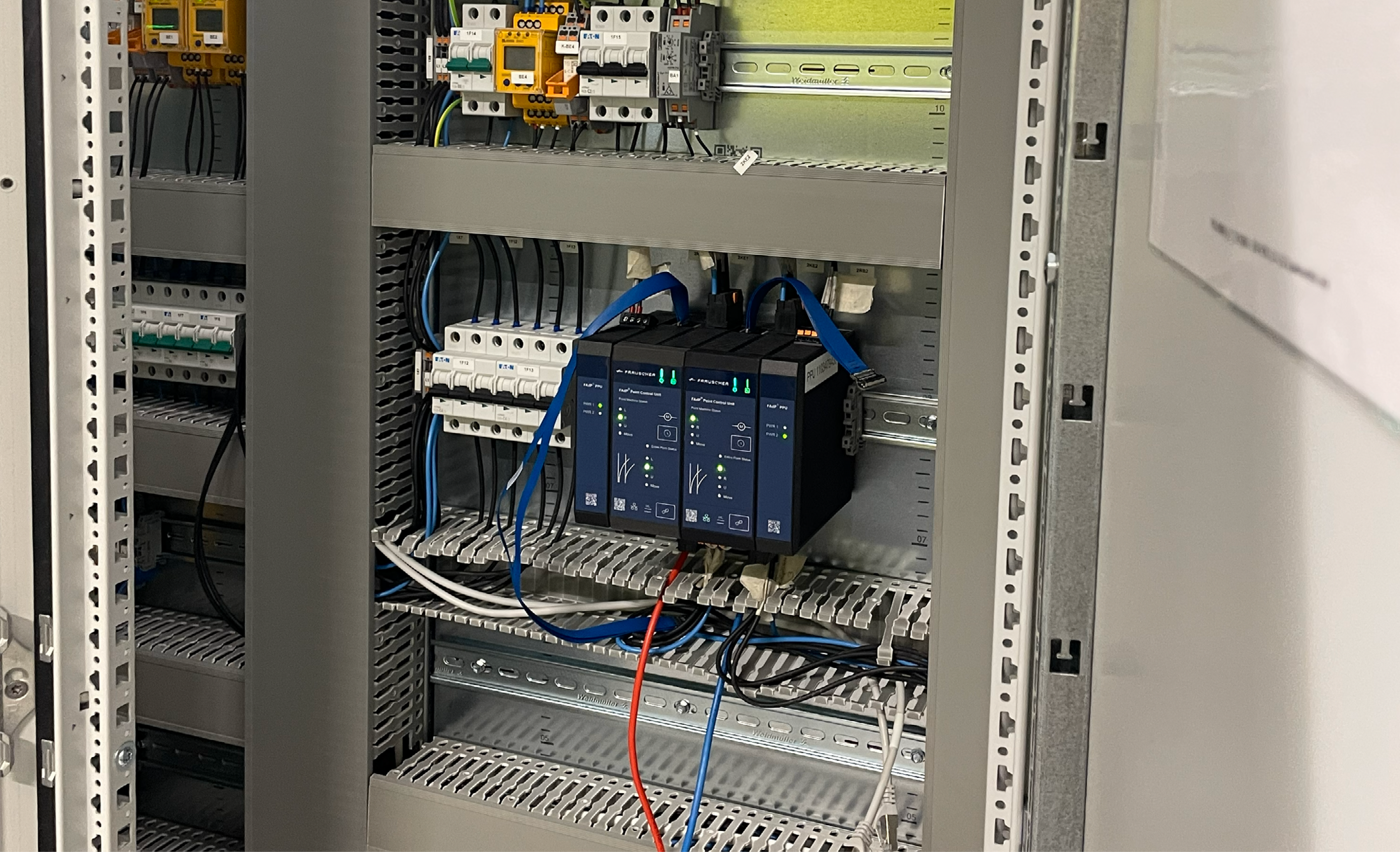
The first integration tests ran between October and November 2025 at the Track Technology Learning Centre in Kouvola under real operating conditions. Following commissioning and configuration, the FAdP Point units delivered precise results from the outset, controlling various Siemens point machine types without difficulty, while point end-position monitoring performed as specified. The test scope also covered encrypted communication via SSI. The project experience confirms that successful multi-vendor integration depends as much on close collaboration between all stakeholders as on the technology itself, particularly around interface parameterisation and subsystem coordination.
A conventional station area with points, track vacancy detection and additional field I/O functions typically requires three separate systems, each with its own cabinet, power supply, climate control and redundant network components – and, where communication is encrypted, two cybersecurity modules per Object Controller. Costs rise accordingly.
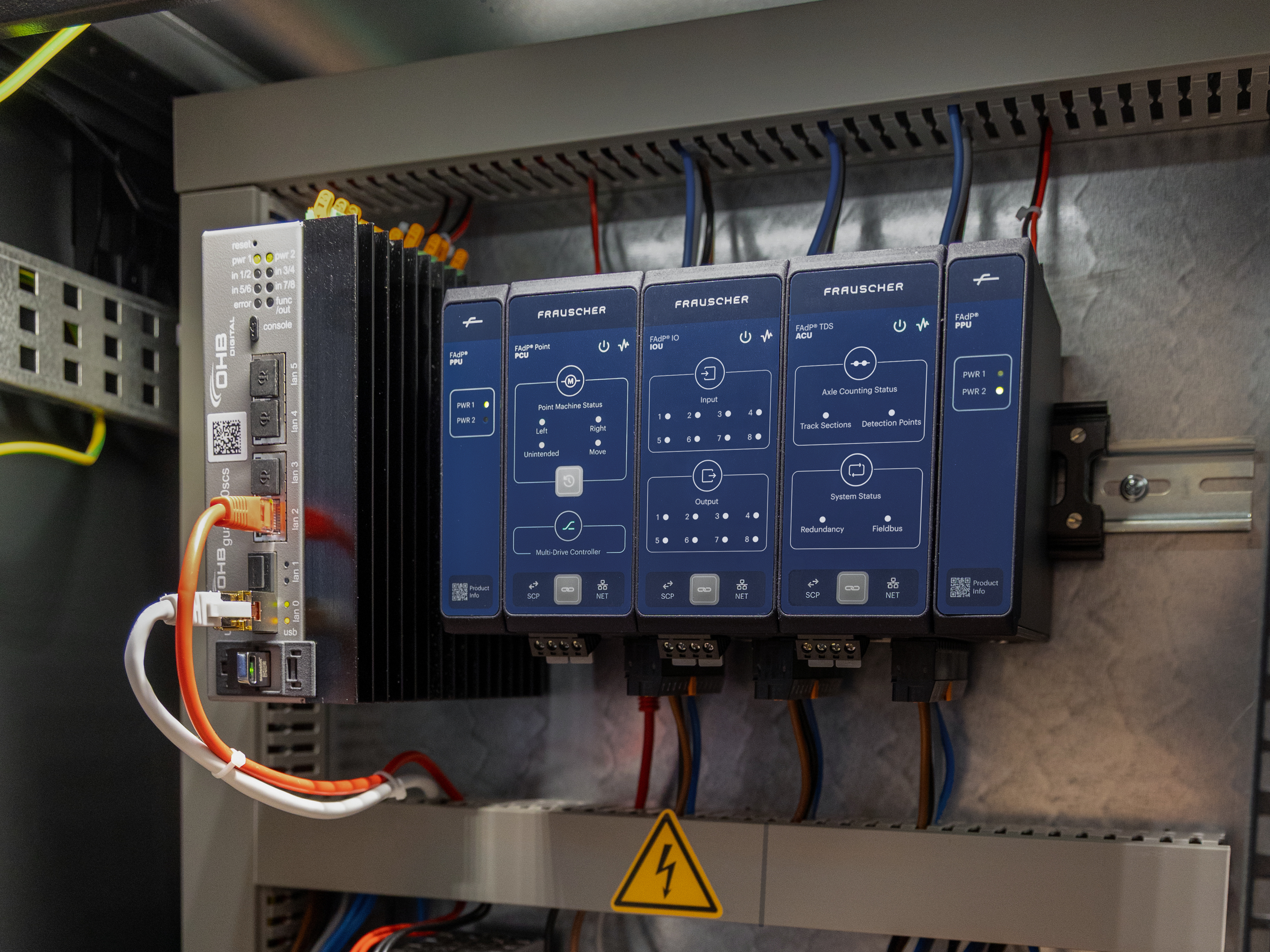
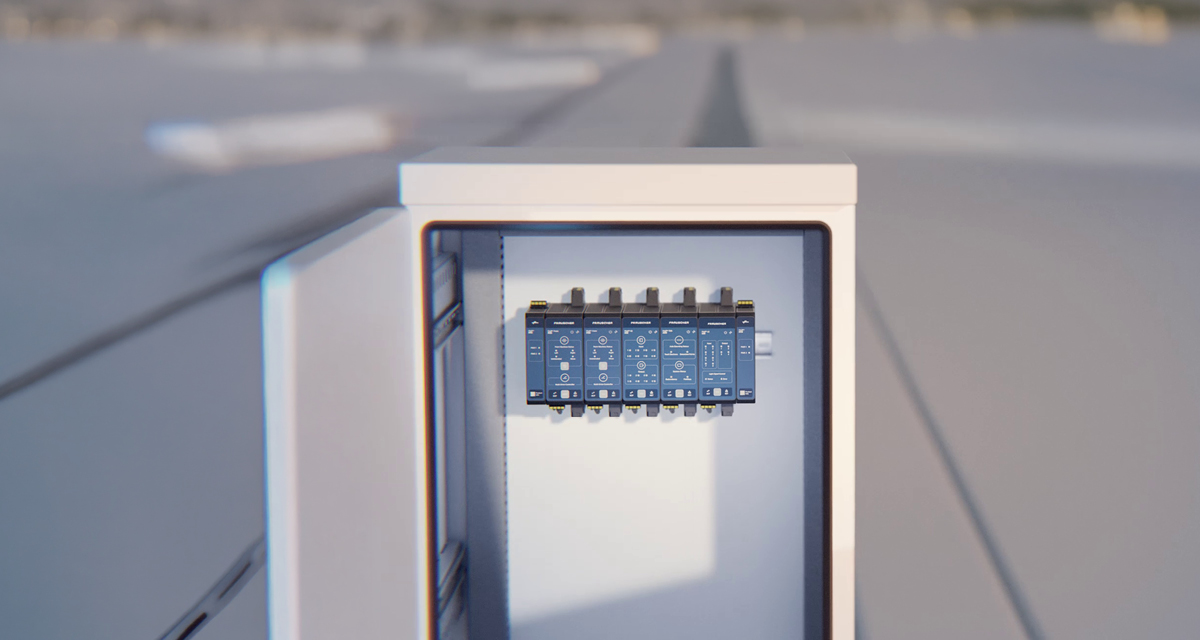
The FAdP platform concept offers a consolidated alternative that is ready for implementation: FAdP Point, FAdP TDS and FAdP IO combined in a single decentralised cabinet, sharing power protection and connectivity infrastructure through two Frauscher Connect Devices. Frauscher Connect supports up to 6 RaSTA connections, implements the standardised EULYNX Baseline 4 interfaces and acts as an OPC-UA aggregator for diagnostic data. In the scenario analysed, this results in a volume reduction of 60 to 80% compared with three separate installations, a single power supply instead of three, and shared climate control that lowers energy consumption and operating costs. Because the underlying hardware platform is identical across all three Object Controller types, configuration remains software-based, and factory acceptance testing, documentation and logistics all benefit from the consolidation.
Many markets still operate relay-based or electronic interlockings, with extensive cabling, proprietary interfaces and strong supplier dependency. A complete interlocking replacement is often not economically or operationally feasible, particularly across large, heterogeneous networks – yet operators increasingly need digital architectures to improve maintainability, scalability and lifecycle efficiency.
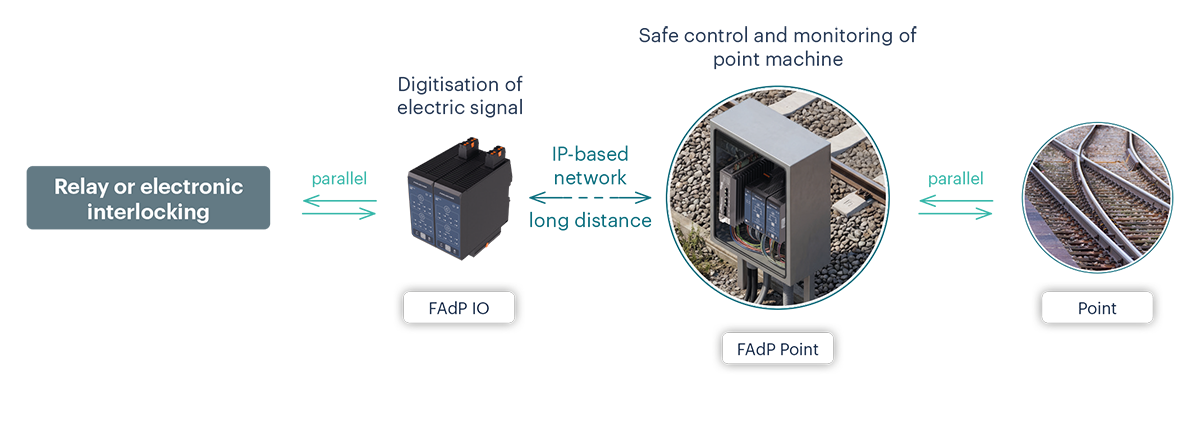
Modern Object Controllers show how such a migration can be realised pragmatically. Where ageing, star-shaped cabling no longer meets availability and safety requirements, FAdP Point can take over safe control and monitoring of the point field element, while FAdP IO acts as an adapter on the interlocking side: it receives the existing electrical signals, translates them into digital signals and transmits them via RaSTA over an IP-based network to FAdP Point. The interlocking logic itself remains unchanged, as FAdP IO emulates the relevant parameters, such as operationally induced delays, of the established connection. Beyond replacing long cable runs, this approach can reduce cable breaks, insulation faults and theft exposure, while providing condition-monitoring data – currents, voltages and mechanical point machine parameters – from day one. Because FAdP Point and FAdP IO are EULYNX-compatible by design, this incremental step keeps a later, fully EULYNX-compliant architecture within reach.
Share this post

Head of Portfolio Strategy
Across all three, the same platform strategy applies: a high proportion of generic components, standardised EULYNX Baseline 4 interfaces, and a consistent separation of safety and security through modular connectivity units. That separation is what allows each approach to follow an independent lifecycle strategy – point control, train detection and I/O can be updated, extended or migrated on their own timeline over service periods of more than 30 years, without one subsystem's upgrade cycle dictating another's.
Taken together, the three scenarios show a generic Object Controller platform that has already left the drawing board: first proven in a multi-vendor setting in Finland, and flexible enough to meet operators wherever their modernisation journey currently stands.
Share this post
Get in touch with our team!
Interested in finding out more about the Frauscher Advanced Platform FAdP?
Share this post
Get in touch with our team!
Interested in finding out more about the Frauscher Advanced Platform FAdP?