Frauscher Sensor Technology has completed the divestiture to Wabtec Corporation.

Extension Line D Tram Bordeaux | France
Train DetectionFrance

Extension Line D Tram Bordeaux

Operator
Keolis
Country
France
Partner
Vossloh-Cogifer
Segment
Urban
Application
Track Vacancy Detection
Products
RSR180, FAdC

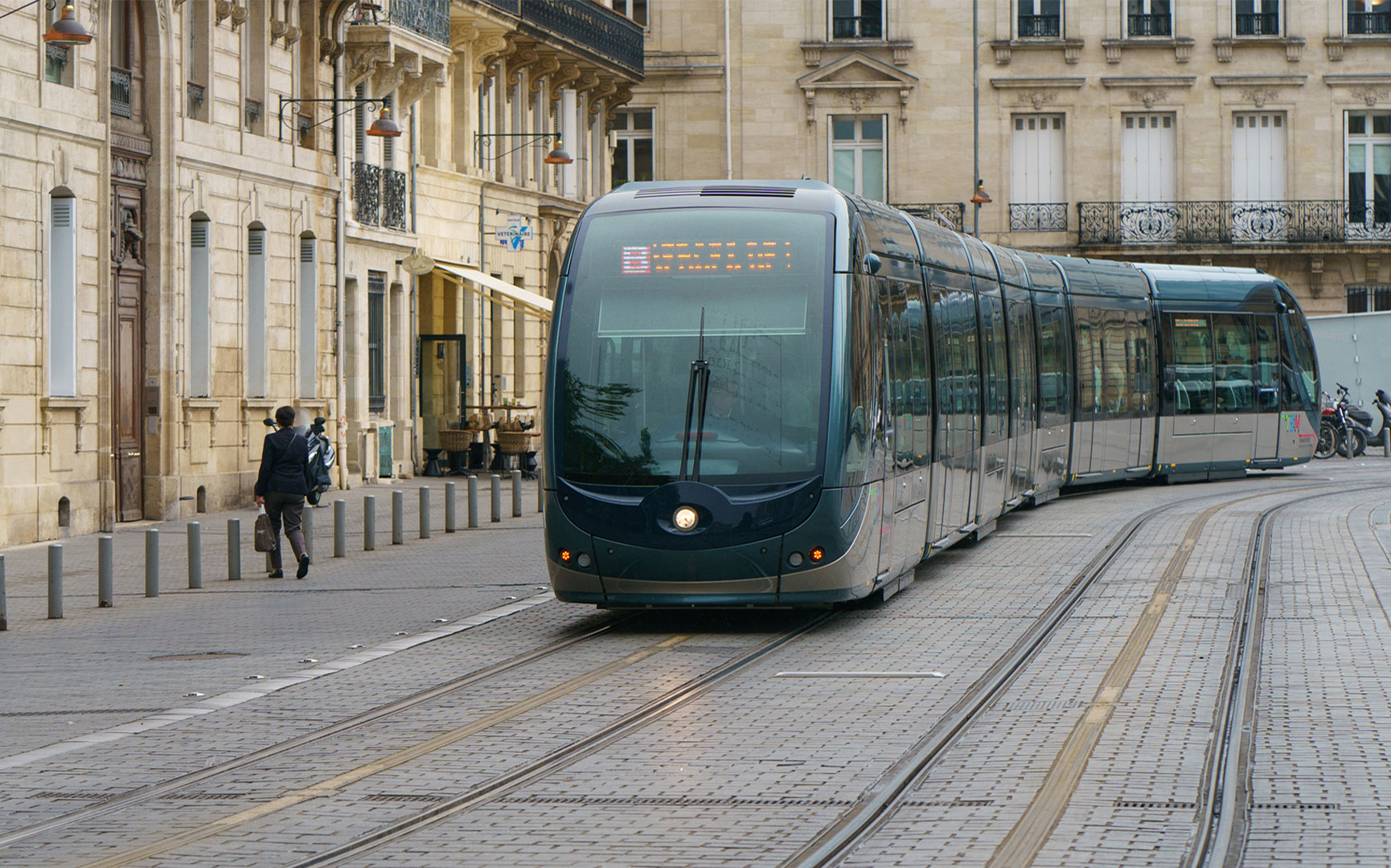
The Bordeaux tramway was the first French tram system equipped with a Frauscher axle counting system, benefitting from the innovative management methods like Counting Head Control.

The D line of the Bordeaux tramway is a tram line which is around 10 kilometres long. A significant challenge of D line is both the availability and reliability of the signals that allow rolling stock to move without incident.

The implementation of the Frauscher Advanced Counter FAdC and Frauscher Wheel Sensor RSR180 support the innovative concept of Counting Head Control. The patented management method can be implemented without additional hardware and compensates counting errors which are common in urban areas.

Innovative management methods

Counting Head Control CHC is a patented concept by Frauscher which supports the availability of operations.

Patented rail claw

The Frauscher Rail Claw SK420 perfectly fits for grooved rails and has been developed especially for this field.

Similar Projects
This might also interest you
1/5
Train DetectionFrance

Homologation for the Île-de-France tramway network

The network of Île-de-France tramways in the region of Paris has been a showcase model of public transport since the line T1 opened in 1992. Over a million passengers use these trams daily and today, the system consists of 11 lines covering over 100 kilometres of track. Over the next years it is planned to expand this network even further. For track vacancy detection, the Frauscher axle counting system is considered as being the ideal solution for this comprehensive network.
Train DetectionSpain

Three-rail Castellbisbal

The dual-gauge system of the Spanish railway network is quite challenging in terms of track vacancy detection: Wheel sensors must be installed on two rails next to each other in tight spaces and have to detect axles reliably on the respective rail. Frauscher developed a solution which copes also with the complexity of different interlocking technology in the stations along the line.
Train DetectionUnited States of America

Reducing Delays in a Metro (subway) Environment

A large metro operator was researching ways to reduce bottlenecks that were causing significant delays at a busy station. With two routes dividing in close proximity to the station and a complex auto-routing system that required the use of a 30-second timer to release switches, trains would frequently back up when approaching the station.
Train DetectionKazakhstan

FAdC at Uglerudnaya Station

AcelorMittal is the operator of the Uglerudnaya industrial railway station, located in Temirtau, Kazakhstan. The station features a total of 56 switches and 52 track sections to enable the smooth flow of train traffic. To ensure the safety of all trains, an interlocking system is used to establish secure routes for incoming, outgoing, and passing trains. This requires effective traffic management and a dependable train detection system to detect the presence of trains on the tracks.
Train DetectionUnited Kingdom of Great Britain and Northern Ireland

London to Corby

The project was part of Network Rail’s Midland Main line electrification programme and involved re-signalling between Bedford and Kettering. The goal is the reduction of industry costs and environmental benefits through lighter rolling stock, reduced fuel costs and lower carbon emissions.